VPN Client
The VPN Client page allows administrators to configure and manage outbound VPN client connections directly on the device. VPN client connections can be used to route traffic through a remote network for secure connectivity, site-to-site access, or policy-based routing. The device supports L2TP with IPSec, providing a widely supported VPN option for remote connectivity.
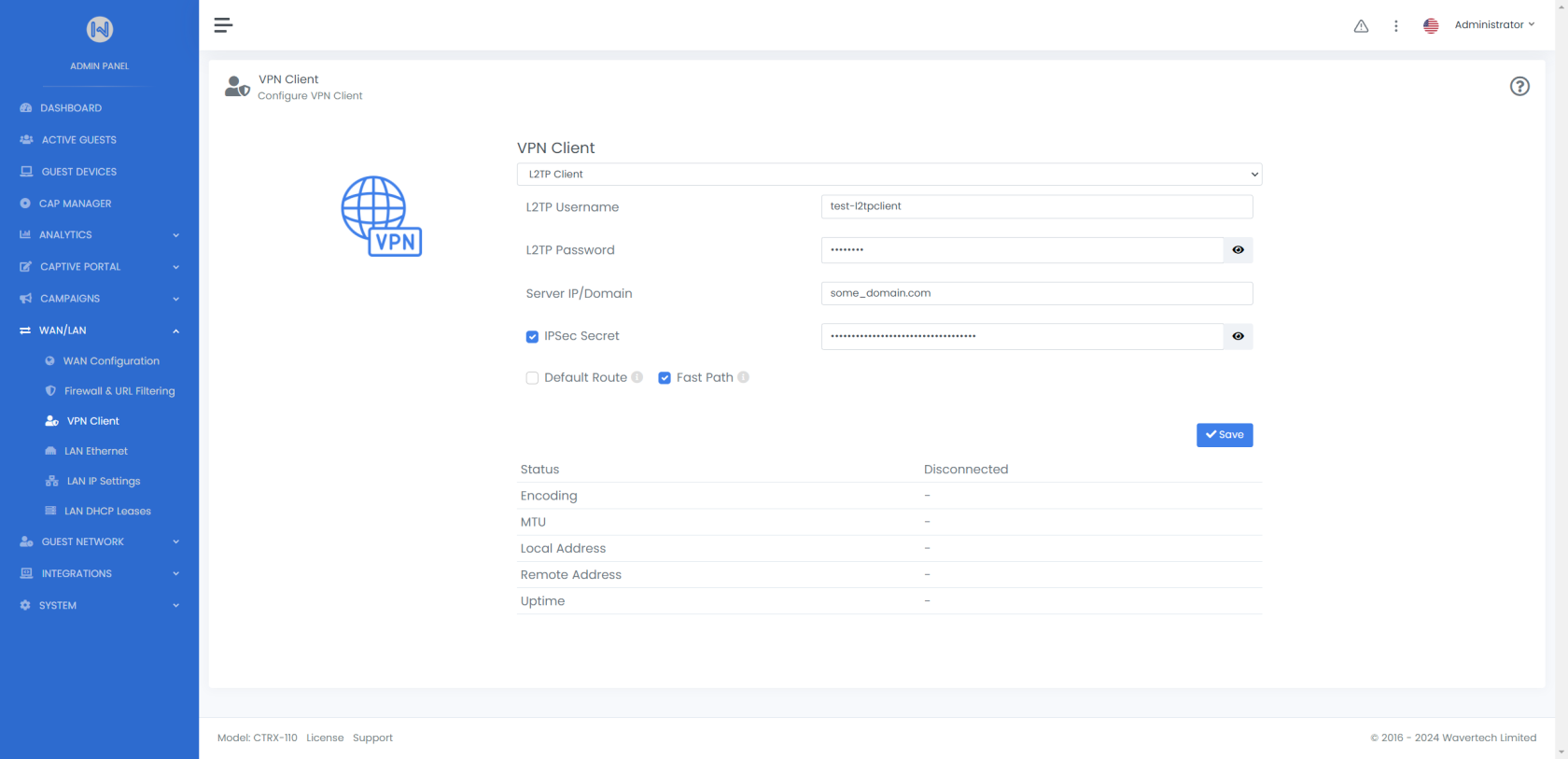
Select your preferred VPN Client type from the dropdown menu.
- Disabled: VPN functionality is turned off.
- L2TP Client: Configure and connect using the L2TP/IPSec protocol.
1. Select VPN Type
- Login to Admin Panel
- Navigate to WAN | LAN > VPN Client section.
- Select a VPN type from the dropdown menu (e.g., PPTP or L2TP).
2. Configure L2TP
- Enter the L2TP Username, Password, and Server IP/Domain.
- Enter IPSec Secret
-
Additional options:
-
Default Route
When enabled, all device traffic will be routed through the VPN tunnel.
-
Fast Path
Enables optimized packet forwarding for improved performance, where supported.
-
Click Save to apply the configuration.
3. Monitor Connection
Check the status table for:
- Connection status.
- Encoding method.
- MTU and IP addresses.
- Connection uptime.
Notes
-
Ensure the VPN server supports L2TP/L2TP with IPSec
-
Use strong authentication credentials and secure IPSec secrets
-
Enable Default Route only when full traffic tunneling is required
-
Verify VPN server compatibility before enabling Fast Path
-
VPN connectivity depends on upstream network availability and firewall rules
The VPN Client feature enables secure outbound connectivity using L2TP/ with IPSec, suitable for site access, secure routing, and controlled traffic forwarding. Configuration and usage should align with the operator’s network design and security requirements.

